.svg)

.svg)
%201.svg)


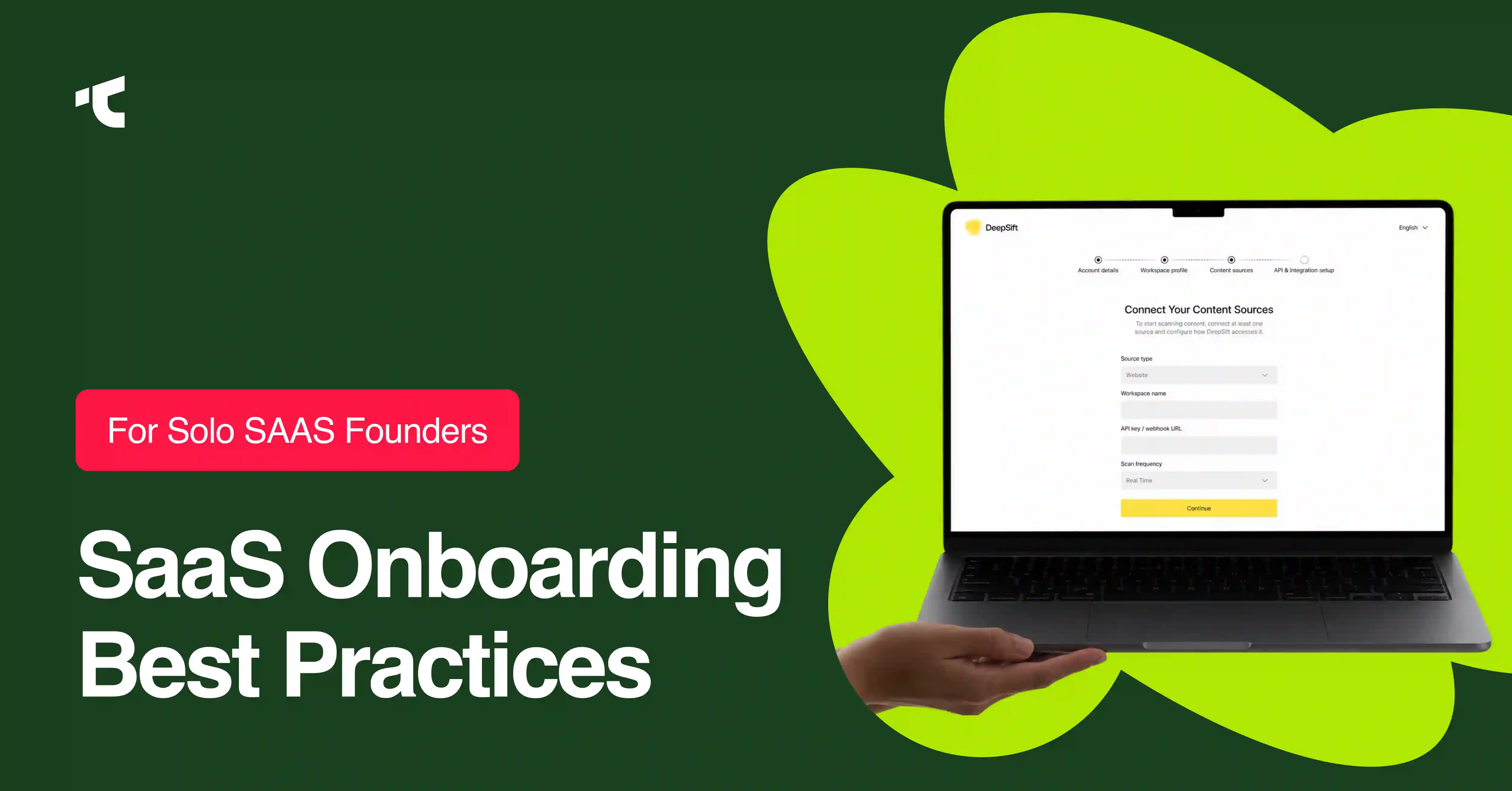
You have already rebuilt your onboarding once. Maybe twice. You hired a freelancer who shipped a cleaner signup screen, you swapped the empty dashboard for something friendlier, and you added a product tour because every SaaS onboarding best practices post told you to. Your activation rate did not move. Your trial-to-paid conversion did not move. Three months later, your MRR is still flat, and you are staring at 8 months of runway, wondering what you missed.
You missed the diagnosis. Most onboarding advice skips straight to solutions. It hands you a list of tactics, a checklist, and a progress bar, then assumes those tactics will fix a problem nobody has actually located. Tactics applied to the wrong problem change nothing. That is why your last redesign moved the UI and left the numbers flat.
This article runs the diagnosis first. You will learn how to find the exact step where users leak, how to define the moment a new user first sees value, and which of your onboarding steps exist for you instead of for them. The fixes come after. They only work once you know what is broken.
Is your onboarding broken? Check these signs:
Signups use the product once and never return.
40 to 60% of free-trial signups use a SaaS product a single time and never come back (Hiver).
Activation rate sits below 40%.
The average SaaS activation rate is 37.5%; a healthy rate is 40 to 50% (AdoptKit).
One specific step shows a steep, repeatable drop.
A single step that consistently loses 25% of users while others lose 5% is a broken step, not a flow problem (Appcues / Jimo).
Trial-to-paid conversion runs in the low single digits.
B2B SaaS typically converts 15 to 25% of trials; sales-led models average 2.4% (OpenView / AdoptKit).
Support tickets cluster around basic setup.
Users default to your most expensive channel when setup is unclear (WhataStory / FullSession).
Time-to-first-value runs in hours or days, not minutes.
Top products reach value in under 15 minutes; the industry average is 1 day, 12 hours (UserTourKit).
Why your onboarding feels logical to you and confusing to everyone else
You designed your onboarding flow with a complete map of the product in your head. Your first user has none of it. The curse of knowledge is the cognitive bias where you cannot unknow what you already know, so you cannot accurately predict what a new user will find confusing. You see a logical sequence. They see a wall of steps between signup and the thing they came for.
That gap shows up in step count. Best-in-class SaaS onboarding delivers the first value moment in 3 to 5 steps. Most founders ship 9 to 13. The extra steps feel necessary to you because each one made sense when you added it. To the user, each one is another chance to leave.
Here is the math founders miss. Each step in your onboarding flow multiplies against the last; it does not add. UserTourKit analyzed 100 SaaS onboarding flows and found that every additional minute in the flow reduces conversion by roughly 3%. Userpilot's 2025 benchmark of 188 companies recorded an average onboarding checklist completion rate of 19.2%, with a median of 10.1%. Four out of every 5 signups never finish the flow you built.
Run a generous version of the math. Hold 80% of users at each step, and a 5-step flow still delivers only 33% of signups to the first value. A 13-step flow delivers 5.5%. Same product, same users, a 6x difference in who reaches value, decided almost entirely by how many steps you put in front of them. You did not build a worse product than your competitor. You built a longer hallway. Most of the UX mistakes that quietly flatten activation start right here, with steps that made sense to the builder and to nobody else.
SaaS onboarding best practices start with diagnosis: 3 questions to answer before you touch anything
Every fix in the next section depends on these 3 answers. Skip the diagnosis, and you are back to redesigning screens and hoping the metrics follow. Answer all 3, and you will know precisely which tactic to apply, at which step, before you change a single line of UI. This diagnostic maps your entire onboarding journey from signup to first value.
Where exactly do users drop off?
The single steepest drop between two consecutive steps is your starting point, not the overall completion number. Pull the onboarding funnel in Mixpanel or PostHog, rank every step transition by its drop-off percentage, and fix the worst one before you touch anything else.
Aggregate completion hides the problem. A flow sitting at 30% completion never tells you where the other 70% went. Step-level data does. Map every event from signup to activation, then read the funnel for the one transition with the steepest fall. A step that loses 25% of users while neighboring steps lose 5% is not a flow problem. It is one broken step. The saas onboarding metrics that predict retention live at the step level, not in the headline number, which is why a single drop-off chart is worth more than a dashboard full of averages. For a deeper guide on which metrics to track, read the Taqwah SaaS metrics guide.
What is your aha moment, and can a new user reach it in under 5 minutes without help?
A new user reaches their aha moment when they complete the first action that delivers core value, and the best SaaS products make that happen in under 5 minutes. AdoptKit puts the average activation rate at 37.5%, so most products lose the majority of signups before this point.
Name the exact event. Not "the user understands the product," but something observable: created their first report, connected their first integration, sent their first invoice. Then time it honestly. Sit down as a brand-new account with no prior knowledge and no support docs open, and count the minutes to that event. Users leave if the first value moment takes longer than a few minutes to reach. Your new users cannot get there either if you cannot reach it in under 5 minutes without help, and no amount of polish on the screens in between will fix that.
Which steps exist to collect data for you rather than deliver value to the user?
Any step that gathers data for your CRM, billing, or analytics without returning visible value to the user is a friction step. Label every onboarding step as a value step or a friction step, then cut each friction step that appears before the aha moment.
This is the fastest cut available to you. Walk the flow one step at a time and tag each one. A value step shows the user something useful: a result, a populated workspace, a working integration. A friction step extracts something for you: a phone number, a team size, a use-case survey that branches your pipeline. Friction steps are not always wrong, but they belong after the first value, not before it. Move required-but-non-urgent collection to the far side of the aha moment, delete the fields you never actually use, and measure the onboarding completion rate again. Rising churn often traces back to friction stacked before value, which is why the average SaaS churn rate punishes long signup flows.
6 SaaS Onboarding Best Practices
These practices show up across the top-ranking onboarding guides for saas businesses, ranked here by how much they move activation. An effective saas onboarding strategy applies one fix at a time. Match each one to what your diagnosis found, ship a single change, and measure before you move to the next. Tactics stacked blindly tend to cancel each other out.
1. Cut every step before the first value.
Reduce the number of steps and form fields between signup and the first value moment. UXCam's 2026 SaaS onboarding benchmark study of 3.9 million signup sessions across 480 products found that cutting the signup form from 7 fields to 3 reduced total funnel abandonment by 44.7%. Count your own steps to the first value. Anything above 5 is a candidate for deletion, and most of what you remove you will not miss.
2. Reduce time-to-value to a single named aha moment.
Shorten the path to the one observable action that delivers core value. AdoptKit benchmarks place time-to-value under 5 minutes for the best SaaS products, and UserTourKit found that every extra minute in the flow costs roughly 3% of conversion. Pick the one action that matters, strip out everything that delays it, and let the rest of the product stay discoverable later instead of being taught upfront.
3. Replace the upfront product tour with contextual guidance.
Stop front-loading a 10-step linear tour that almost nobody finishes and trigger guidance at the moment each feature becomes relevant. Pendo research shows users who adopt at least 3 core features during onboarding retain 40% better, so guide users toward those specific features in context rather than narrating the entire interface at signup. A tooltip that fires when a user lands on the relevant screen beats a carousel they click through only to dismiss.
4. Personalize the onboarding experience with a 2-to-4-question welcome survey.
Capture the user's role or primary goal at signup and branch the user onboarding experience from the first screen. Appcues identifies 2 to 4 questions as the range that personalizes the flow without feeling like a form, and a Qualaroo study found that more than 2 survey prompts during onboarding can reduce completion by up to 15%. A marketing lead and an engineer who signed up for different reasons should not land on the same first step.
5. Add an onboarding checklist with a visible progress bar.
Show new users a short checklist of 3 to 5 items with a visible progress bar so momentum stays in view. Best-in-class flows reach 67% checklist completion with progress indicators against a 35% average without them, per Wyzowl data, and UXCam measured a single progress bar cutting first-stage drop-off from 38.4% to 24.1%. Small visible wins compound across the steps that follow. The empty screen a user lands on is itself a decision, and the first dashboard they see either invites the next action or stalls it. For a deeper look at empty state and dashboard design, read the Taqwah guide on how to design a SaaS dashboard.
6. Build a self-serve help layer inside the product.
Users search for answers at the moment they get stuck, not before. A resource center embedded inside the product reduces support tickets and keeps users in the onboarding flow. WhataStory and FullSession data show that support tickets cluster around basic setup tasks when in-app guidance is absent. Place searchable help, short video walkthroughs, and relevant tooltips inside the product where users already are. A user who finds the answer without leaving the app is more likely to convert than one who opens a support ticket or closes the tab.
Track these saas onboarding metrics before and after every change
Onboarding metrics tell you whether a fix worked or only felt like it did. Track 3 numbers at minimum: activation rate, onboarding completion rate, and trial-to-paid conversion. Activation rate measures how many signups reach the aha moment. Onboarding completion rate measures how many finish the full onboarding journey. Trial-to-paid conversion measures whether the onboarding flow is producing paying customers, not just active free users. Change one thing, measure all 3, then decide what to fix next. Improving your onboarding without tracking these numbers is the same mistake as redesigning the UI without running the diagnosis first.
Why most onboarding best practices content did not help you
Generic advice is written for a product the author has never seen. The diagnostic step is the one thing every onboarding listicle skips. A list of 12 tactics cannot tell you which one matches your specific leak, because it does not know where you are leaking. So you applied a progress bar to a flow whose real problem was a 7-field signup form, and nothing moved.
Best practices are a starting point, not a prescription. The same tactic that lifts one product's activation rate does nothing for another, because the underlying problem is different. The founder who moves metrics reads the data first and applies tactics second. Diagnosis tells you which of the 6 fixes above is yours. The full saas onboarding strategy only works once the diagnosis points you at the right page of it. For a full breakdown of the most common design errors that break onboarding flows, read our guide on SaaS UX mistakes.
Frequently asked questions about SaaS onboarding best practices:
What are the core steps of an effective SaaS onboarding process?
The 5 core steps of an effective SaaS onboarding process are: reduce signup friction to 3 fields or fewer, define one observable aha moment, build a short onboarding checklist with a progress bar, trigger contextual guidance at the moment each feature becomes relevant, and measure activation rate and trial-to-paid conversion separately after every change.
How long should a SaaS onboarding flow take?
A SaaS onboarding flow should deliver the first value moment within the first session, ideally under 5 minutes for self-serve products. Full setup should complete within 7 to 30 days through staged checkpoints. Products that take longer see 90% higher churn among users who do not activate in the first 3 days.
Which SaaS onboarding metrics should I track?
Track 3 SaaS onboarding metrics at minimum: activation rate, onboarding completion rate, and trial-to-paid conversion. Activation rate measures signups who reach the aha moment. Onboarding completion rate measures how many finish the full user onboarding journey. Trial-to-paid conversion measures whether the onboarding flow produces paying customers.
How does personalization improve the user onboarding experience?
Personalization improves the user onboarding experience by routing users to the features most relevant to their role or goal from the first screen. A 2-to-4-question welcome survey at signup captures enough context to branch the onboarding flow without adding friction. Users who see a personalized onboarding experience are more likely to convert than users who go through a one-size-fits-all flow.
What are the most common SaaS onboarding mistakes?
The 4 most common SaaS onboarding mistakes are: stacking friction steps before the aha moment, running a generic product tour instead of contextual guidance, measuring overall completion rate instead of step-level drop-off, and applying best practices without first running a diagnostic to find the actual leak.
Start with the diagnosis
Reading this far means you already suspect your onboarding is leaking and are not sure where. That is a diagnosis problem, not a design problem, and it is fixable in 30 minutes.
Taqwah runs a free 30-minute onboarding teardown. We pull apart your current onboarding flow, find the steepest drop-off step, and tell you which of the fixes above matches it. It is a diagnosis, not a sales call. You leave with the specific step to fix, whether or not you ever work with us. Taqwah works with saas businesses at the $2K to $30K MRR stage. Our diagnostic-first audit goes deeper for $2,000 if you want the full picture, with the leak mapped end to end and a prioritized fix list. See how we work at Taqwah Services.
You built the product. You don't have to figure out where it's leaking alone.




.avif)