.svg)

.svg)
%201.svg)


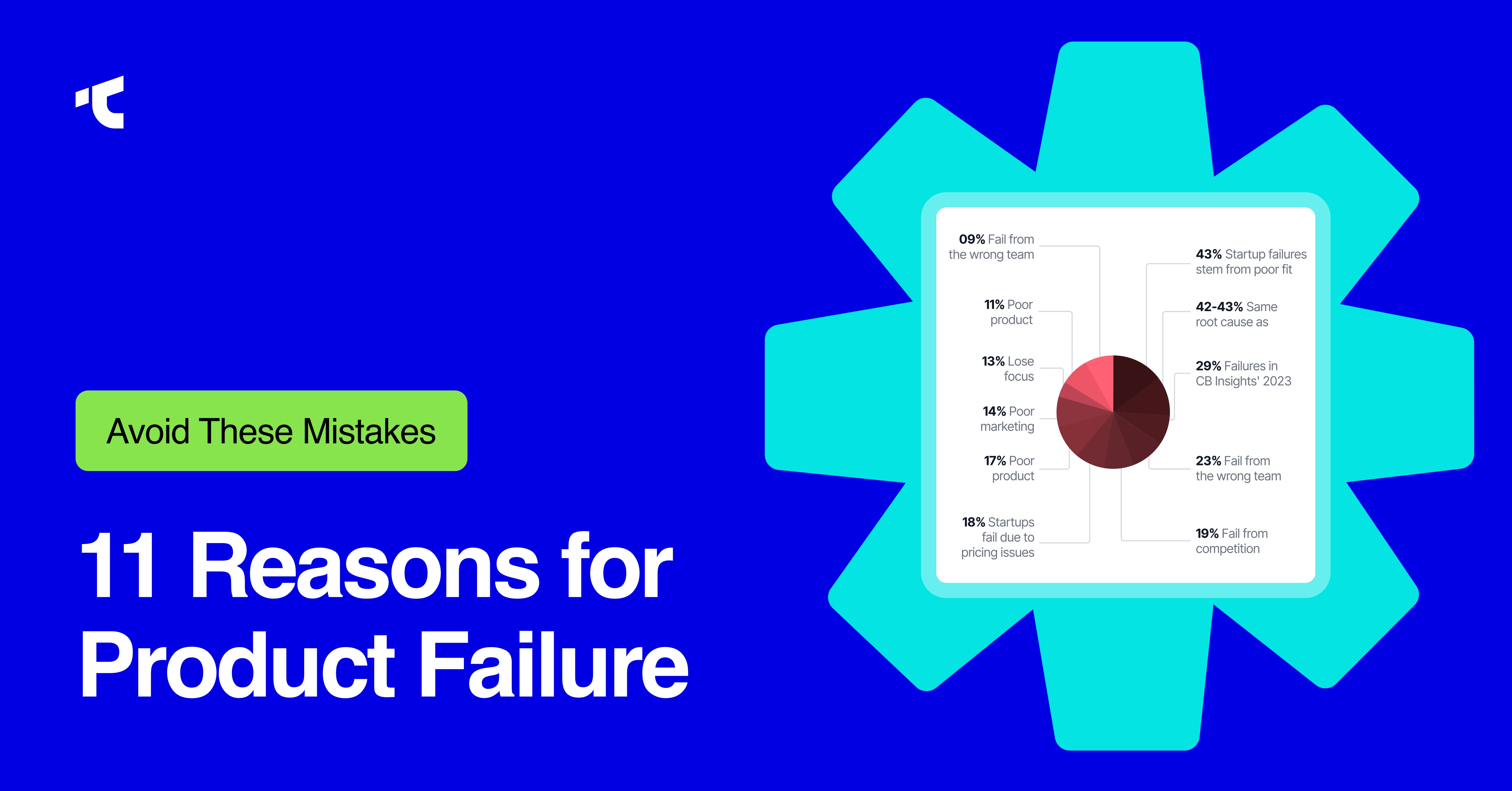
There are 11 main reasons for product failure: poor market research, weak product-market fit, ignoring customer feedback, wrong pricing, poor value proposition, delayed market entry, failure to differentiate, poor execution, poor marketing, limited functionality, and mismanaged teams. Product failure occurs when a product does not meet revenue, adoption, or customer satisfaction goals.
The product failure rate remains high across industries. Harvard Business School professor Clayton Christensen estimated that around 30,000 new products enter the market each year, and about 80% of them fail. The reasons for product failure in the market repeat across companies, categories, and decades, which means teams can learn from them, predict them, and avoid them.
This article explains why products fail, lists examples of product failures, and shows how product management practices such as market research, minimum viable product (MVP) validation, and usability testing prevent new product failures.
What Is Product Failure?
Product failure is the inability of a product to achieve its intended business goals, such as revenue targets, market share, user adoption, or customer satisfaction, within a defined time after launch.
A failed product loses money, damages brand reputation, and consumes team resources without returning value.
Product failure appears in 3 common forms, including commercial failure, technical failure, and strategic failure.
- Commercial failure happens when a product does not generate enough sales to cover its development and marketing costs.
- Technical failure happens when a product does not perform its core function reliably, such as products with performance issues or safety defects.
- Strategic failure happens when a product succeeds technically but conflicts with the company's business model, brand, or go-to-market strategy.
What Are the Main Reasons for Product Failure?
The main reasons for product failure are the absence of market demand, weak product-market fit, ignored customer feedback, wrong pricing strategy, poor value proposition, delayed market entry, no differentiation, poor execution, poor marketing, limited functionality, and internal management problems. CB Insights found that 35% of startups fail because there is no market need for their product.
The 11 reasons for product failure are listed below.
- Skipping market research
- Missing product-market fit
- Ignoring customer feedback
- Choosing the wrong pricing strategy
- Communicating a poor value proposition
- Entering the market too late
- Failing to differentiate from competitors
- Executing the product development poorly
- Marketing the product launch weakly
- Shipping limited functionality and performance issues
- Managing the product team badly
1. Skipping Market Research
Skipping market research causes product failure because teams build products based on internal assumptions instead of verified market demand. Companies that skip research misjudge the target audience, the target market size, and the willingness of customers to pay.
Market research answers 4 critical questions, including who the customer is, what problem the customer has, how many customers exist, and how much customers will pay. Teams that answer these 4 questions before product development reduce the risk of building a product nobody wants.
There are 5 proven market research methods for new products, these are:
- Conduct customer interviews to hear the problem described in the customer's own words.
- Run landing page tests to measure real purchase intent before building anything.
- Analyze competitor reviews to find unmet needs in existing products.
- Distribute surveys to quantify how widespread the problem is across the target market.
- Study search volume data to confirm that people actively look for a solution.
A famous example of skipped research is Juicero. The company raised $120 million for a Wi-Fi-connected juice press priced at $699. Journalists later showed that customers could squeeze the juice packs by hand, without the machine. Research with real users would have revealed that the machine added no value, and the product shut down in 2017.
2. Missing Product-Market Fit
Missing product-market fit causes product failure because the product solves a problem that is too small, too rare, or already solved for the target audience. Product-market fit means a product satisfies strong market demand from a clearly defined customer segment.
Marc Andreessen defined product-market fit as "being in a good market with a product that can satisfy that market." A product without fit shows 3 warning signs, including slow user growth, high churn, and low word-of-mouth referrals.
There are 4 reliable signals of product-market fit, these are:
- Measure retention curves that flatten instead of declining to zero.
- Track organic growth from referrals and word of mouth.
- Run the Sean Ellis test, in which more than 40% of users say they would be "very disappointed" without the product.
- Monitor payback periods that shorten as adoption grows.
Google Glass illustrates a missing fit. The device offered impressive technology, but consumers found no daily problem it solved, worried about privacy, and rejected the $1,500 price. Google withdrew the consumer version in 2015 because demand never matched the engineering effort.
3. Ignoring Customer Feedback
Ignoring customer feedback causes product failure because teams continue investing in features, designs, and roadmaps that users have already rejected. Customer feedback is the most direct measurement of whether a product meets customer needs.
Feedback arrives through 6 main channels, including support tickets, app store reviews, user interviews, usability testing sessions, churn surveys, and social media mentions. Teams that collect feedback but do not act on it fail in the same way as teams that never collect it.
There are 5 effective ways to act on customer feedback, these are:
- Categorize feedback into themes such as usability, pricing, and missing features.
- Prioritize themes by frequency and revenue impact on the product roadmap.
- Close the loop by telling users which requests shipped.
- Test changes with real users before a full release.
- Repeat the cycle in every agile iteration.
New Coke is the classic feedback failure. In 1985, Coca-Cola replaced its original formula after taste tests showed people preferred the sweeter new version. The taste tests measured sips, not loyalty. Customers protested for 79 days until the company returned the original formula as "Coca-Cola Classic." The lesson: collect feedback on the right question, and listen when customers answer.
4. Choosing the Wrong Pricing Strategy
Choosing the wrong pricing strategy causes product failure because a price that is too high blocks adoption and a price that is too low destroys margins and perceived quality. Pricing communicates the value proposition faster than any marketing message.
Wrong pricing takes 4 common forms, including overpricing against substitutes, underpricing below sustainable margins, confusing tier structures, and misaligned billing models.
There are 5 steps to set the right price for a new product, these are:
- Research competitor prices across the target market before setting your own.
- Interview customers about willingness to pay using methods such as Van Westendorp analysis.
- Match the pricing model to the usage pattern, such as subscription for continuous value.
- Test price points with A/B experiments on landing pages.
- Review pricing quarterly, because market demand and competition change.
Amazon's Fire Phone shows overpricing in action. Amazon launched the phone in 2014 at $199 with a contract, the same price as the iPhone, despite offering a weaker app ecosystem. Sales stalled, Amazon cut the price to 99 cents within weeks, and the company wrote off $170 million in inventory.
5. Communicating a Poor Value Proposition
Communicating a poor value proposition causes product failure because customers cannot understand what the product does, who it serves, or why it beats alternatives. A value proposition is the clear statement of the benefit a customer receives.
A strong value proposition answers 3 questions in one sentence, including what the product is, who the product helps, and why the product is better than the alternative.
There are 4 rules for writing a clear value proposition, these are:
- Lead with the outcome the customer achieves, not the features the product contains.
- Name the target audience explicitly, so the right customers self-select.
- Quantify the benefit with a specific number, such as time saved or cost reduced.
- Contrast with the alternative, so the differentiation is obvious.
Segway demonstrates a value proposition failure. The 2001 launch promised to revolutionize transportation, but the company never explained who needed a $5,000 standing scooter or which trip it replaced. Segway projected 50,000 units in the first year and sold about 24,000 units in nearly 5 years.
6. Entering the Market Too Late
Entering the market too late causes product failure because competitors capture the customers, the distribution channels, and the mindshare before the product arrives. Delayed market entry converts a potential competitive advantage into a permanent disadvantage.
Late entry happens for 3 main reasons, including perfectionism in product development, slow internal approvals, and underestimated engineering complexity.
There are 5 practices that accelerate market entry, these are:
- Launch a minimum viable product that tests the core value with real users.
- Cut scope aggressively, shipping one problem solved well instead of ten solved poorly.
- Set immovable launch dates and adjust scope, not schedule.
- Automate quality assurance so testing does not delay releases.
- Release in stages, starting with a beta group before the full product launch.
Microsoft's Windows Phone entered the smartphone market in 2010, 3 years after the iPhone and 2 years after Android. Developers had already committed to the two established ecosystems, so the app gap never closed. Microsoft discontinued Windows Phone in 2017 despite strong hardware and design.
7. Failing to Differentiate From Competitors
Failing to differentiate causes product failure because customers have no reason to switch from an existing product that already satisfies their needs. Differentiation is the unique value a product delivers that competitors do not.
A product differentiates on 5 possible dimensions, including price, quality, features, experience, and brand. Products that match competitors on every dimension compete only on marketing budget, and the incumbent usually holds the larger budget.
There are 4 ways to build clear differentiation, these are:
- Identify underserved segments that market leaders ignore.
- Solve one painful problem dramatically better than any competitor.
- Design a distinctive experience that customers describe to friends.
- Combine features in a package that no single competitor offers.
Google+ shows undifferentiated failure. The 2011 social network copied the core mechanics of social media leaders such as Facebook without offering a compelling reason to switch. Users kept their friends, photos, and habits on the incumbent network, and Google shut down Google+ for consumers in 2019.
8. Executing the Product Development Poorly
Executing poorly causes product failure because defects, delays, and design flaws destroy customer trust even when market demand exists. Poor execution turns a validated idea into a broken product.
Execution failures appear in 4 areas, including engineering quality, product design, supply chain, and safety testing.
There are 5 execution practices that prevent product failure, these are:
- Adopt agile development with short iterations and continuous integration.
- Run usability testing on the design and prototypes before engineering begins.
- Enforce quality assurance gates that block releases with critical defects.
- Pilot manufacturing at a small volume before mass production.
- Test edge cases under real-world conditions, not laboratory conditions.
Samsung's Galaxy Note 7 is the defining execution failure. Battery defects caused phones to overheat and catch fire in 2016. Samsung recalled 2.5 million units, then recalled the replacements, and finally discontinued the product. The failure cost Samsung an estimated $5.3 billion and years of brand reputation repair.
9. Marketing the Product Launch Weakly
Marketing weakly causes product failure because customers cannot buy a product they have never heard of, no matter how well it solves their problem. A product launch requires a go-to-market strategy that reaches the target audience through the channels they already use.
Weak launches share 4 symptoms, including undefined target audiences, generic messaging, single-channel promotion, and no post-launch follow-through.
There are 6 elements of a strong go-to-market strategy, these are:
- Define the target audience with specific demographics, behaviors, and pain points.
- Craft channel-specific messaging that matches how each audience segment consumes content.
- Prepare launch assets such as demos, case studies, and press kits in advance.
- Activate multiple channels, including email, social media, partnerships, and paid acquisition.
- Brief the sales team on objection handling and competitive comparisons.
- Sustain momentum with a 90-day post-launch content and outreach plan.
Crystal Pepsi failed partly due to misaligned marketing. Pepsi launched the clear cola in 1992 with a Super Bowl campaign built on purity, but the taste did not match the visual promise, and the messaging never explained why clarity mattered. Pepsi withdrew the product within 2 years.
10. Shipping Limited Functionality and Performance Issues
Shipping limited functionality causes product failure because customers abandon products that lack essential features or perform more slowly than the alternatives they already use. A minimum viable product must still be viable: the core function must work completely and reliably.
Functionality failures are split into 2 types: missing must-have features and degraded performance, such as crashes, lag, and battery drain.
There are 5 ways to ship the right functionality, these are:
- Distinguish must-have features from nice-to-have features using customer interviews.
- Benchmark performance against the fastest competitor, not against internal targets.
- Load-test infrastructure at 10 times the expected launch traffic.
- Instrument the product with analytics that reveal where users struggle.
- Fix reliability issues before adding any new feature to the roadmap.
Cyberpunk 2077 demonstrates performance failure at scale. The 2020 game launched with severe bugs and crashes on older consoles, and Sony removed the game from the PlayStation Store for 6 months. CD Projekt Red issued refunds, lost 75% of its stock value from the peak, and spent years repairing the product and its brand reputation.
11. Managing the Product Team Badly
Managing the product team badly causes product failure because unclear ownership, shifting priorities, and internal politics prevent even talented teams from shipping coherent products. Product management exists to align business goals, customer needs, and engineering capacity.
Management failures show up in 4 patterns, including no single decision-maker, constantly changing requirements, siloed departments, and leaders who override user research with personal opinions.
There are 5 management practices that protect products from internal failure, these are:
- Assign one accountable product manager who owns the product roadmap.
- Freeze requirements within each development iteration.
- Share user research across design, engineering, and marketing teams.
- Set measurable success metrics before development starts.
- Kill failing projects early, redirecting the team before losses compound.
Quibi collapsed under management failure. The mobile-video startup raised $1.75 billion, but leadership ignored user research showing people wanted to share clips and watch on TVs, and launched with neither capability. Quibi shut down in 2020, only 6 months after launch.
What Are Famous Examples of Product Failures?
Famous examples of product failures include New Coke, Google Glass, Amazon Fire Phone, Segway, Microsoft Windows Phone, Samsung Galaxy Note 7, Juicero, Google+, Crystal Pepsi, and Quibi. Each failed product maps to at least one of the 11 reasons above.
The table below summarizes 10 examples of product failures and their primary causes.
How to Avoid Product Failure?
To avoid product failure, validate market demand before building, launch a minimum viable product early, collect customer feedback continuously, price against measured willingness to pay, and differentiate clearly from competitors. Prevention costs less than any post-launch rescue.
There are 7 proven steps to avoid new product failure, these are:
- Validate the problem with at least 20 customer interviews before writing any code.
- Build a minimum viable product that tests the riskiest assumption first.
- Test usability with 5 or more real users in every design iteration.
- Measure product-market fit with retention curves and the Sean Ellis test.
- Price the product using willingness-to-pay research, not cost-plus guesswork.
- Plan the go-to-market strategy at least 90 days before the product launch.
- Define kill criteria so the team stops investing in a failing product early.
Follow all 7 steps, if you want to protect the product from the most common failure patterns. Skip any single step, and the product inherits the corresponding risk from the 11 reasons above.
Why Do Most New Products Fail?
Most new products fail because teams build solutions before validating problems, which means the absence of market demand — not bad engineering — is the leading cause of new product failure. CB Insights ranks "no market need" as the top startup failure reason at 35%, ahead of running out of cash at 38% for combined financial reasons in later analyses.
The pattern repeats across the examples of product failures in this article: Juicero engineered brilliantly for a problem nobody had, Google Glass answered a question nobody asked, and Quibi funded a format nobody wanted. Market research, customer feedback, and MVP validation exist precisely to catch these failures before launch, when the cost of change is lowest.
Final Thoughts
Product failure follows predictable patterns, and each of the 11 reasons has a proven prevention practice. Teams that research the market, validate with a minimum viable product, listen to customer feedback, price deliberately, launch on time, and differentiate clearly convert failure risk into competitive advantage. The companies behind failed products such as New Coke, the Fire Phone, and the Galaxy Note 7 all recovered by applying these same lessons — and your team can apply them before launch instead of after.




.avif)