.svg)

.svg)
%201.svg)



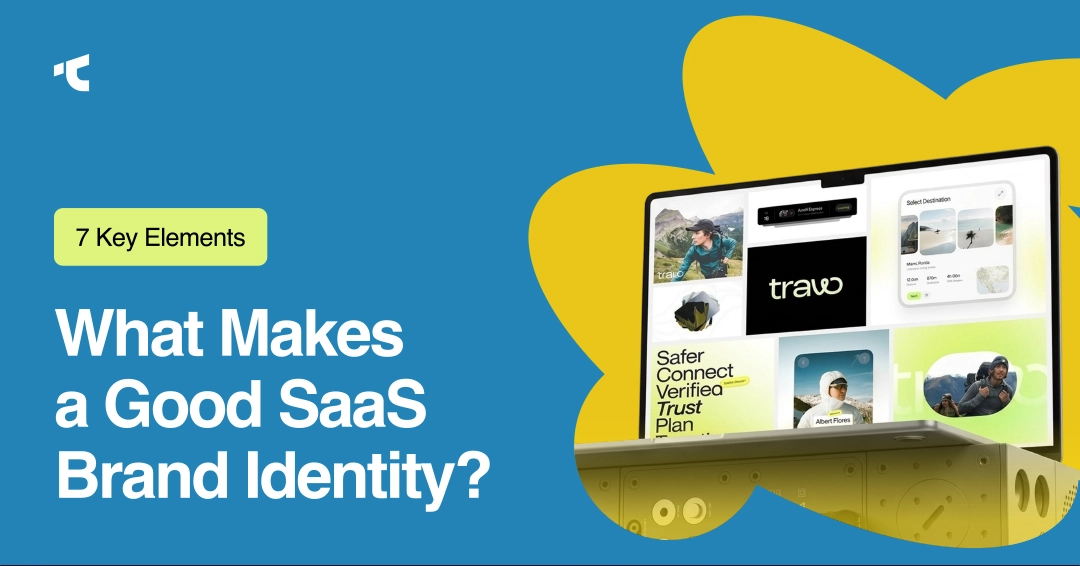
SaaS brand identity is the complete system of visual, verbal, and experiential signals, logo, color palette, brand voice, messaging, and product experience that communicate who a software company is and why it deserves customer trust. A 2024 Forrester study found that SaaS brands with clear identities achieve 20% higher customer retention than those without.
The SaaS market reached $250.8 billion in 2024, 7 times higher than in 2015, with 95% of businesses now using at least 1 SaaS solution. In a crowded market that crowded, products competing on identical features cannot win on features alone. Identity becomes the primary way to differentiate a product.
This guide covers the 7 key elements of a strong SaaS brand identity, verified against SERP consensus, with specific examples from Slack, Notion, HubSpot, and Intercom.
What Is SaaS Brand Identity?
SaaS brand identity is the structured set of decisions a software company makes about how it presents itself, visually, verbally, and emotionally, to its target customers across every touchpoint.
3 core components form a complete SaaS brand identity: identity (your vision, values, and unique traits that distinguish you from competitors), messaging (how you articulate what your software offers and why it matters to target users), and user experience (from the user interface to customer support, shaping how users perceive your brand).
SaaS branding carries a unique challenge that consumer goods do not: you are selling something invisible. Customers cannot hold your product; they rely on perception, trust, and reputation to make buying decisions. That dependency on trust makes brand identity the infrastructure every other go-to-market decision runs on.
Why Does SaaS Brand Identity Matter?
SaaS brand identity drives customer acquisition, retention, and revenue by building the trust that software buyers require before committing to a recurring subscription.
A brand identity that resonates with a user signals that the platform is reliable, unique, and invested, delivering 6 measurable outcomes: instant credibility on arrival, clear differentiation in a crowded market, stronger customer loyalty, greater marketing effectiveness, shorter sales cycles, and better product adoption.
SaaS businesses with retention rates above 85% grow 1.5–3x faster than those below that threshold. Brand identity is a direct input to that retention rate; it determines whether customers trust you enough to stay when competitors come knocking.
What Are the 7 Key Elements of a Strong SaaS Brand Identity?
The 7 key elements of a strong SaaS brand identity are clear brand positioning, a unique value proposition, consistent visual identity, a defined brand voice, brand-product alignment, emotional resonance, and consistency across all touchpoints. Each element reinforces the others to build recognition, trust, and topical authority.
1. Clear Brand Positioning
Brand positioning defines the specific place a SaaS company occupies in the minds of target customers relative to all competitors. Effective positioning answers why a specific buyer should choose your product over all alternatives, built on a clear understanding of your audience, their problem, and your unique solution.
SaaS companies differentiate through 4 routes: narrow positioning (owning a specific niche), distinctive brand personality (a clear voice and point of view), community building (creating network effects around your brand), or values-led branding (standing for something your target audience cares about).
Verified example: When Sturdy AI, a B2B SaaS platform, repositioned from a generic business intelligence tool to "the first platform that turns customer conversations into strategic insights," that positioning clarity doubled their monthly inbound leads.
Action step: Write 1 positioning sentence that names your target customer segment, their specific pain point, and your measurable differentiator. Validate it with 5 potential customers before publishing.
2. A Unique Value Proposition That Addresses Real Pain Points
A unique value proposition (UVP) is the 1-sentence commitment that tells target customers what specific outcome they gain by choosing your SaaS product over all alternatives.
Your unique value proposition shapes every interaction and defines how customers perceive your brand, built by understanding customer challenges, identifying what sets your service apart, and spotlighting key advantages that are easy to grasp and remember.
HubSpot's UVP, "Grow better," speaks directly to businesses seeking scalable growth. Dropbox's brand essence, "simplify your life," guides its minimalist design and user-friendly product decisions. Both examples demonstrate that a strong UVP functions as both a strategic anchor and a creative brief for every brand decision that follows.
The mistake most SaaS companies make: Overused buzzwords like "innovative" or "cutting-edge" dilute uniqueness. Canva demonstrates the alternative, emphasizing "empowering everyone to design" over generic tech jargon.
3. Consistent Visual Identity Across All Platforms
Visual identity in SaaS branding includes 5 components applied consistently across all platforms: logo, color palette, typography, imagery style, and iconography.
A SaaS brand must communicate trust, sophistication, clarity, and product value within seconds. A modern visual identity improves conversion, credibility, and usability, not aesthetics alone.
Color palette: Analyzing competitor colors reveals differentiation opportunities. If all fintech solutions use green and blue, that does not mean your SaaS brand must follow the same pattern, a bold, unexpected color choice can make your product stand out in a crowded market. The 60-30-10 rule, 60% dominant color, 30% secondary, 10% accent, provides a reliable starting structure.
Typography: Clean sans-serif typography that supports fast reading under pressure signals reliability and keeps content accessible across devices and use cases.
Verified example: Notion's warm, minimalist visual identity, beige and black color palette, clean typography, simple logo, translated directly into its product interface, creating a seamless brand-product experience that enables word-of-mouth because the brand is easy to describe and recommend.
Action step: Create a brand style guide documenting exact color hex codes, approved fonts with sizes, logo usage rules, and image guidelines. Audit all brand touchpoints quarterly against this guide.
4. A Defined Brand Voice That Reflects Your Audience
Brand voice is the consistent personality and tone a SaaS company uses across all communication, website copy, onboarding emails, in-product microcopy, support replies, and social media.
Brand voice is not just about what you say, but how you say it. A well-defined tone connects with your audience, reflects your brand's personality, and separates you from competitors across 4 key dimensions: friendly vs. formal, contemporary vs. traditional, cheerful vs. serious, and innovative vs. classic.
A practical brand voice guide includes 3–4 personality traits (for example: "curious, straight-talking, optimistic, technically sharp"), do/don't examples for each trait, and guardrails for where tone flexes, more playful in product tours, more sober in legal or security pages.
Brand voice examples for B2B SaaS:
Slack, the B2B workplace messaging SaaS, built its brand on a casual, witty, and distinctly human voice, injecting personality into traditionally boring business software through bold colors, friendly illustration, and consistent microcopy throughout the product. Bold branding attracts attention and creates preference when features commoditize.
Intercom, the B2B customer messaging platform, uses a direct, helpful, and conversational voice that aligns precisely with its brand positioning around better customer conversations, practicing what it preaches by communicating like humans, not corporations.
5. Brand-Product Alignment
Brand-product alignment means the promises a SaaS brand makes in marketing are delivered inside the actual product, including onboarding flow, UI, documentation quality, and customer support responsiveness.
If your brand is about simplicity but your onboarding process is confusing, that disconnect erodes trust immediately. If you position yourself as innovative but your interface feels dated, users notice. Consistency across every touchpoint, support responsiveness, documentation quality, and even email signatures, builds trust; inconsistency destroys it.
In SaaS, your onboarding is your brand. It creates first impressions, reduces friction, and teaches value fast. A product experience that contradicts the brand promise destroys credibility faster than any competitor action can.
Verified example: Notion's brand-product alignment works because its flexible, user-controlled product mirrors its "empowering" brand positioning, creating compound effects where the brand enables word-of-mouth because it's so easy to describe and recommend.
6. Emotional Resonance and Brand Storytelling
Emotional resonance in SaaS branding means shifting communication from product features to customer transformation, showing how the software changes a user's work, reduces stress, or enables measurable growth.
92% of customers revisit brands that provide emotional connection, according to Harvard Business Review. 70% of buying decisions are based on how the customer feels treated, according to McKinsey.
The strongest SaaS brands sell a vision of a better future, not just software. Slack is not about messaging; it's about making work more human. Shopify is not about e-commerce; it's about empowering entrepreneurs to build their dreams. This emotional layer transforms customers into advocates who recommend the product to their network.
Verified example: Notion, the all-in-one workspace SaaS, uses brand language as an emotional signal. When its platform crashes, it displays "Notion is having a siesta. We'll be back soon!", maintaining user trust even during failure moments by reinforcing a brand personality that is professional and approachable.
7. Consistency Across All Touchpoints
Consistency across all touchpoints means applying the same visual identity, messaging tone, and brand values across every customer-facing surface, website, product UI, email campaigns, social channels, sales decks, and customer support interactions.
Brand consistency can increase revenue by 10–20%. Customers trust a brand when messaging, design, and interactions remain consistent; they learn what to expect, which makes them more likely to stay loyal and share positive experiences with others.
The most common failure mode: Companies sabotage strong branding by letting different teams create their own versions, marketing uses one voice, sales uses different slides, the product team designs features that don't match the website. These disconnects confuse customers and weaken overall brand impact.
Action step: Distribute a single brand guidelines document, covering messaging rules, visual standards, and tone guidelines, to every team that produces customer-facing output: marketing, product, sales, and support.
Top Elements of a Successful SaaS Brand Identity: Quick Reference
The top elements of a successful SaaS brand identity, ranked by their impact on customer acquisition and retention:
- Brand positioning defines who you serve and how you differ from competitors
- Unique value proposition, communicates the specific outcome customers gain
- Visual identity, logo, color palette, typography, and imagery are applied consistently
- Brand voice, the tone, and personality used across all communications
- Brand-product alignment, brand promises verified by the actual product experience
- Emotional resonance, the transformation narrative that moves customers beyond features
- Consistency across all touchpoints, the same identity applied everywhere customers interact with your brand
B2B SaaS Branding: How It Differs From B2C
B2B SaaS branding differs from B2C in 3 fundamental ways: longer sales cycles involving multiple decision-makers, more complex value propositions requiring technical clarity, and higher trust stakes since buyers commit recurring budget, not a one-time purchase.
B2B SaaS branding regularly involves sophisticated problems communicated through technical capabilities that are difficult to explain simply. Effective branding distills complexity into clear positioning that resonates with target buyers without oversimplifying to the point of meaninglessness.
B2B SaaS companies achieve the highest customer retention at 90%, benefiting from high switching costs, product integration, and recurring value delivery that makes churn organizationally disruptive. Brand identity directly supports that retention by reducing the perceived risk of committing to a long-term subscription.
Budget guidance: Early-stage SaaS startups at pre-seed to seed stage should invest 5–10% of their marketing budget in brand foundations, positioning, basic visual identity, and a messaging guide. Series A+ companies should allocate 15–20%, as brand recognition compounds marketing ROI significantly.
How to Build a Strong SaaS Brand Identity: 6 Steps
Building a strong SaaS brand identity requires 6 steps executed in sequence:
Step 1: Define your brand essence. Your brand essence is the single idea that captures who you are. Identify 3–5 core values that align with this essence and validate them with customer surveys or interviews before documenting them.
Step 2: Write your unique value proposition. Identify your customers' most specific pain point. Write 1 sentence that names the outcome you deliver. Test it with 5 potential customers for immediate comprehension.
Step 3: Build your visual identity. Apply the 60-30-10 color rule. Select 1–2 typefaces that reflect your brand personality. Design a logo that scales from a 16px favicon to a large-format display without losing clarity.
Step 4: Define your brand voice. Write 3–4 personality traits. Create do/don't examples for each. Set guardrails for where tone flexes across product, marketing, and support contexts.
Step 5: Align brand with product. Audit your onboarding flow, UI copy, and support interactions. Identify every touchpoint where the product experience contradicts your brand promise and resolve each gap.
Step 6: Document, distribute, and enforce brand guidelines. Continuously refine your branding strategy through regular reviews of visual identity components to ensure they resonate with your target audience as market dynamics evolve. Quarterly audits are the minimum cadence for growing SaaS companies.
Branding Strategies for SaaS That Cut Through the Noise
The 4 most effective branding strategies for SaaS companies competing in a crowded market are narrow positioning, radical visual differentiation, community-led brand growth, and content as brand authority.
Narrow positioning produces more impact than broad positioning because specificity creates resonance with the exact buyers you need. The more precisely you name who you serve and what outcome you deliver, the more inevitable your brand feels to that audience.
Radical visual differentiation separates SaaS brands that get noticed from those that blur together. Slack's radical visual differentiation in enterprise communication, a fun, colorful brand making a work tool feel less like work, attracted attention and created preference in a category where features had commoditized.
Community-led growth converts users into brand amplifiers. Notion's template ecosystem and Figma's design community both demonstrate how user participation in brand creation generates network effects that paid marketing cannot replicate.
Content as brand authority compounds over time. A strong content strategy communicates expertise and reinforces brand values; each guide, blog post, or video becomes a piece of the larger story that defines your brand and draws readers closer to your solution.
Common SaaS Branding Mistakes to Avoid
The 4 most common SaaS branding mistakes are inconsistent visuals, generic messaging, neglecting product touchpoints, and isolating the brand from product teams.
Mismatched logos, colors, or fonts across your website, app, and emails confuse users. A brand style guide with clear guidelines, audited quarterly, prevents this.
Poor onboarding, slow support, or clunky UX tarnish a brand regardless of how strong its visual identity and messaging are. Every customer-facing surface is a brand moment. Treating any of them as secondary creates gaps that erode trust systematically over time.
Improving SaaS retention by just 5% can increase long-term company valuation by 25–95%. Branding mistakes that drive churn cost far more than the investment required to prevent them.
Conclusion
A good SaaS brand identity combines 7 elements: clear positioning, a unique value proposition, consistent visual identity, a defined brand voice, brand-product alignment, emotional resonance, and consistency across all touchpoints into 1 coherent system that builds trust at every stage of the customer journey.
Features can be copied. Pricing can be matched. A distinctive, well-executed brand identity creates a sustainable competitive advantage that neither of those forces can neutralize.
Start with positioning. Build a visual and verbal identity that reflects it. Ensure the product delivers what the brand promises. Enforce consistency everywhere customers interact with your company. That sequence, not budget, not design talent alone, separates SaaS brands that grow from SaaS brands that disappear into the background.




.avif)