.svg)

.svg)
%201.svg)


User-centered design and human-centered design are two of the most powerful approaches in modern design, and honestly, they're also two of the most misunderstood.
Both put people at the core of the design process. Both rely on real user research, iterative testing, and empathy. So it's completely fair to ask: are they even different things? They are, and the difference matters more than most people realize.
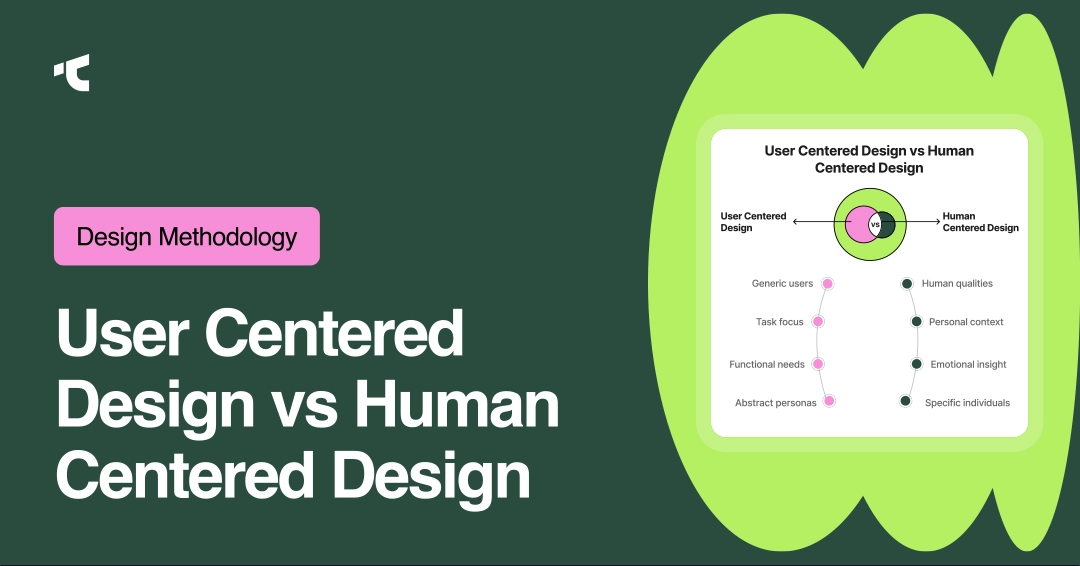
UCD targets a defined user group interacting with a digital product. HCD zooms out further, considering the broader human experience across society, culture, and environment. The difference lies in scope, intent, and stakeholders.
This guide breaks down what each approach actually means, walks you through the design process for each, and helps you figure out when to use UCD, HCD, or a hybrid of both across 9 key factors.
But before we get to the differences, let's make sure we're on the same page about what each one actually is.
What is User-Centered Design?
Imagine your team is building a hospital appointment booking app. You have a deadline, a budget, and a developer who's confident he knows what users need. So he builds it, 10-step registration, English-only interface, heavy page load. Launch day comes. Nobody uses it.
That's what happens when you skip UCD.
User-centered design is a design approach that builds digital products around a specific target user's tasks, goals, and context of use. The idea is simple: instead of designing what you think people need, you design around what they actually do, struggle with, and try to accomplish.
The ISO 9241-210 standard formally defines UCD as an iterative process covering four activities: context analysis, requirements specification, design solutions, and evaluation against requirements. You don't just do it once and ship. You loop through it until the product genuinely works for real people.
In practice, UX designers apply UCD to interfaces, mobile applications, SaaS dashboards, and e-commerce platforms. The success metric isn't "does it look clean?" it's user task completion. Can the user actually do what they came to do?
4 Core Principles of User-Centered Design
The Interaction Design Foundation defines UCD around four principles. Think of these as the rules of the game:
1. Early focus on users and tasks: Before a single wireframe gets drawn, UCD teams identify who the target users are and what tasks they need to complete. Not assumptions, actual research. This is what stops you from building that unusable hospital app in the first place.
2. Empirical measurement: UCD runs on data, not gut feeling. Task completion rates, error frequency, and time-on-task are the numbers that drive decisions, not what the designer personally finds intuitive. If users are failing at step 3, you fix step 3. Simple as that.
3. Iterative design: No design is final on the first try, and in UCD, that's not a failure, it's the whole point. Teams revise prototypes across multiple cycles based on usability testing data. Each round gets you closer to something that actually works.
4. Participatory design: Users aren't just interviewed at kickoff and forgotten. They stay involved at every stage of the design process, reviewing prototypes, flagging confusion, and validating decisions. They're collaborators, not just research subjects.
The User-Centered Design Process
The UCD process follows 5 stages, defined by the ISO standard. Picture it less like a straight line and more like a feedback loop; you'll often move back and forth between stages as you learn more.
Stage 1. Plan the human-centered process:
Before anything else, teams define the project scope, identify key stakeholders, and set clear success metrics. What does "good" look like? Who's involved? This stage makes sure everyone's aligned before a single pixel gets designed.
Stage 2. Specify the context of use:
Now the real research starts. Who are your target users? What tasks are they trying to complete? What environment are they in, a noisy office, a slow mobile connection, a hospital waiting room? Context shapes everything.
Stage 3.Specify user requirements:
This is where teams translate research into requirements, both functional requirements (what the product must do) and usability requirements (how easy it must be to do it). Think of this as the brief that designers actually design from.
Stage 4. Produce design solutions:
Designers build wireframes, mockups, and interactive prototypes based on those requirements, not personal preference, not trend-chasing. Everything ties back to what users actually need.
Stage 5. Evaluate against requirements:
UX researchers run usability tests with real users to see whether the design actually meets their needs. If it doesn't, you loop back. If it does, you're ready to ship or ready to raise the bar and go again.
What Is Human-Centered Design?
Now, let's say your team solved the hospital app problem with UCD. Great. But then you discover something during research, many patients in rural areas don't have smartphones at all. The app, no matter how well-designed, won't reach them.
That's the question HCD is built to ask.
Human-centered design is a design approach that solves problems by considering the full human context, emotions, motivations, cultural background, social systems, and environmental impact across communities and societies. It doesn't just ask "can this user complete this task?" It asks, "Are we even solving the right problem for the right people?"
HCD targets the entire person, not a defined "user" interacting with an interface. That's why it extends well beyond digital products.
Practitioners apply HCD to healthcare systems, education programs, public policy, humanitarian aid, and physical product design. The Stanford d.school and the IDEO.org Field Guide to Human-Centered Design are the two most widely cited frameworks for putting HCD into practice.
Core Principles of Human-Centered Design
HCD runs on four principles that push designers to think bigger and act faster:
1. People-centered Everything starts with the people you're designing for — not a user persona on a slide deck, but real humans with real lives, real constraints, and real context. In the hospital example, that means going to the village, not just running a Zoom interview.
2. Highly creative HCD actively encourages divergent thinking and unconventional solutions. The answer isn't always an app. Sometimes it's an SMS system, a community health worker, or a completely different model altogether. No idea is too weird to explore early.
3. Iterative, just like UCD, HCD refines solutions through repeated cycles of prototyping and feedback. The difference is the scale; you might be prototyping a community service, not just a checkout flow.
4. Bias toward action HCD favors building tangible prototypes over extended analysis. You don't wait until you have the perfect plan. You build something rough, put it in front of real people, and learn from what happens.
The Human-Centered Design Process
The HCD process moves through 3 phases, as defined by IDEO's framework. Unlike UCD's structured 5-stage process, HCD is more fluid; the phases often overlap and feed back into each other.
Phase 1. Inspiration:
Designers immerse themselves in the lives of the people they're designing for. This means ethnographic research, deep interviews, and direct observation, not surveys. The goal is to uncover unmet needs that people might not even be able to articulate. In our hospital example, this is where you'd discover the smartphone gap.
Phase 2. Ideation:
Cross-functional teams, designers, researchers, community members, subject matter experts synthesize those insights into opportunity areas. Then they brainstorm widely, challenge assumptions, and build low-fidelity prototypes of the most promising ideas. Speed matters here; you're exploring, not perfecting.
Phase 3. Implementation:
Teams refine their prototypes, pilot solutions in real-world contexts, and scale what actually works. Implementation in HCD isn't just shipping code, it might mean training community workers, partnering with local organizations, or changing a policy. The measure of success is real-world impact, not app store ratings.
User Centered Design vs Human Centered Design: 9 Key Differences
The difference between user-centered design and human-centered design spans 9 measurable factors. The comparison table below summarizes each factor.
1. Scope of Audience
UCD targets a defined user persona, for example, "freelance accountants aged 30 to 50 using invoicing software." HCD targets the broader human community connected to the problem, including end users, support networks, society, and the environment.
2. Primary Goal
UCD optimizes usability metrics such as task completion time, error rate, and System Usability Scale (SUS) scores. HCD optimizes well-being outcomes such as health, equity, financial inclusion, or environmental sustainability.
3. Research Method
UCD uses quantitative methods, A/B testing, eye-tracking, click maps, and moderated usability tests. HCD uses qualitative ethnographic methods, contextual inquiry, in-home interviews, shadowing, and journey mapping.
4. Output Type
UCD produces digital outputs such as websites, mobile apps, and SaaS dashboards. HCD produces broader outputs, including physical products, service blueprints, organizational systems, and public policy interventions.
5. Time Horizon
UCD operates on sprint-based or release-based cycles measured in weeks. HCD operates on multi-month or multi-year horizons because behavioral and societal change requires sustained intervention.
6. Stakeholder Range
UCD considers the end user as the sole stakeholder. HCD considers end users, secondary stakeholders, communities, ecosystems, and downstream effects on society and the environment.
7. Success Metric
UCD measures success through usability KPIs, conversion rate, task success rate, and time on task. HCD measures success through behavioral indicators, quality-of-life surveys, and longitudinal community outcomes.
8. Originating Standard
ISO 9241-210:2019 codifies UCD with formal technical requirements. The IDEO.org Field Guide and the Stanford d.school Bootleg codify HCD as a flexible methodology rather than a formal standard.
9. Typical Practitioner
UX designers, interaction designers, and product designers practice UCD. Service designers, social innovators, and design researchers practice HCD on cross-functional teams.
Similarities Between UCD and HCD
UCD and HCD share 5 foundational traits that often confuse:
- People-first orientation: Both approaches reject designer-driven assumptions and start with real people.
- Iterative process: Both methods cycle through research, prototyping, and testing repeatedly.
- Empathy as a tool: Both approaches use empathy interviews and observation to surface unmet needs.
- Cross-functional collaboration: Both methods involve designers, researchers, engineers, and business stakeholders.
- Real user validation: Both approaches test prototypes with real users before launch.
UCD operates as a subset of HCD when applied to digital products. Don Norman, who coined the term "user experience" at Apple in 1993, has publicly stated that the term "user" is too narrow and prefers "human-centered" as the broader framing.
When Should You Use User-Centered Design?
Teams should use user-centered design when 4 conditions apply:
- The project is a digital product with a defined user group.
- Success is measurable through usability metrics.
- The development cycle runs on agile sprints.
- The business goal is conversion, retention, or engagement.
UCD examples include Slack’s onboarding flow, Stripe’s checkout interface, and Airbnb’s search filters, all digital interfaces refined through usability testing with target users.
When Should You Use Human Centered Design?
Teams should use human-centered design when 4 conditions apply:
- The problem affects a community or social system.
- Success requires behavioral or systemic change.
- The solution involves products, services, and policies together.
- The project horizon spans 6 months to multiple years.
HCD examples include IDEO.org’s SmartLife water-purification service in Kenya, the Mayo Clinic’s Center for Innovation patient experience redesign, and the UK Government Digital Service’s GOV.UK platform, all interventions that addressed broader human systems beyond a single interface.
What is an example of User-Centered Design?
UCD at Spotify
Spotify’s product team applied UCD to redesign the Discover Weekly playlist in 2015. Researchers ran usability tests with 200 users, measured engagement through play-through rates, and iterated the recommendation interface across 6 design cycles. The redesign increased Discover Weekly streams by 40% within 12 months.
What is an example of Human-Centered Design?
HCD at IDEO
IDEO applied HCD to redesign the Embrace infant warmer for low-resource hospitals in India. Designers spent 8 weeks immersed in rural Indian clinics, observed neonatal care practices, and identified that traditional incubators failed because rural hospitals lacked reliable electricity. The Embrace warmer, which uses a phase-change material and requires no continuous power, has saved more than 200,000 premature infants since launch.
The Spotify case illustrates UCD’s digital-product focus. The Embrace case illustrates HCD’s systemic, society-level impact.
Combining UCD and HCD: The Hybrid Model
Mature design teams combine UCD and HCD rather than choosing one. The hybrid model uses HCD for problem framing and UCD for solution refinement.
A 4-step hybrid workflow:
- HCD discovery: Conduct ethnographic research to define the human problem.
- HCD ideation: Generate solutions across products, services, and policies.
- UCD specification: Translate the chosen solution into user requirements.
- UCD evaluation: Test the digital implementation with target users through usability testing.
This hybrid model appears in design systems at Google, IBM (Enterprise Design Thinking), and SAP (Design-led Development).
Conclusion
User-centered design vs human centered design is a question of scope, not of opposition. UCD optimizes digital interfaces for defined users through usability testing and ISO-standardized iteration. HCD addresses systemic human problems for communities through ethnographic research and broad stakeholder engagement.
Choose UCD for digital products with defined user groups and usability KPIs. Choose HCD for products, services, and systems that affect community well-being. Combine both approaches in a hybrid model when projects require systemic problem framing followed by digital product refinement. The 9 differences across scope, goal, method, output, horizon, stakeholders, metrics, standards, and practitioners give design teams a structured framework to select the right approach for each project.
Frequently Asked Questions
What is the main difference between user-centered design and human-centered design?
User-centered design focuses on a specific user’s interaction with a digital product, while human-centered design focuses on the broader human experience across society and the environment. UCD measures usability; HCD measures well-being and systemic change.
Is user-centered design the same as human-centered design?
No, user-centered design and human-centered design are not identical. UCD is a narrower subset of HCD that targets defined users of digital products. HCD targets entire communities and considers emotional, social, and environmental factors beyond product interaction.
What is an example of human-centered design?
A great example of human-centered design is the Embrace infant warmer, designed by IDEO and Stanford d.school students for rural Indian hospitals. The product addresses neonatal mortality through a low-cost device that works without continuous electricity, demonstrating HCD’s focus on broader human and systemic needs.
Does HCD or UCD work better for SaaS products?
UCD works better for SaaS products because SaaS success depends on defined user tasks, measurable usability, and rapid iteration. HCD applies when SaaS products serve vulnerable populations or involve organizational change beyond the interface.
Are UI and UX based on UCD or HCD?
UI and UX practice draws primarily from UCD because both fields target digital interface usability and user experience metrics. UX practitioners increasingly incorporate HCD principles when products affect well-being, accessibility, or marginalized communities.UCD
Which design approach leads to better conversion rates?
(User-Centered Design) tends to drive better conversion rates for specific digital products. A frictionless UX design, the hallmark of UCD, can potentially raise conversion rates by up to 400%. UCD's iterative, task-focused testing directly optimizes usability, making it more conversion-effective than HCD's broader societal focus.
Is User-Centered Design part of Design Thinking?
No, UCD is not part of Design Thinking; they are separate but complementary practices. UCD is a specific application focused on creating user-friendly products, while Design Thinking is broader, considering business goals, technological feasibility, and societal impacts
User Centered Design vs Human Centered Design vs Design Thinking
Design thinking is a third related framework that overlaps with both UCD and HCD. The Stanford d.school defines design thinking through 5 stages: empathize, define, ideate, prototype, and test. Design thinking is the broadest of the three, applied to business strategy, organizational change, and innovation programs in addition to product design
UCD is a subset of HCD applied to interfaces. HCD is a subset of design thinking applied to people-focused problems. Design thinking encompasses both UCD and HCD, plus business model innovation.



.avif)